Quickstart tutorial
This document helps you get up-and-running with alr immediately. It should give you a general idea of how to get started with this package.
Introduction
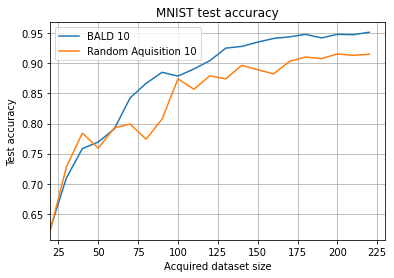
In this document, we will use alr to run a simple active learning experiment on MNIST. The goal of this experiment is to show the effectiveness of using a proper acquisition function over randomly sampling unlabelled points (often referred to as random acquisition). The model is more likely to improve with fewer acquisitions when using a good acquisition function.
Loading and preparing datasets
In this section, we define some training hyperparameters, create data loaders, and define the experiment function which we will reuse for different acquisition functions.
[ ]:
%matplotlib inline
import torch
import torch.utils.data as torchdata
import matplotlib.pyplot as plt
from torch.nn import functional as F

from alr import MCDropout
from alr.acquisition import BALD, RandomAcquisition
from alr.data import DataManager, UnlabelledDataset
from alr.data.datasets import Dataset
from alr.training import Trainer
from alr.training.samplers import RandomFixedLengthSampler
from alr.utils import manual_seed, eval_fwd_exp, timeop

# reproducibility
manual_seed(42, det_cudnn=False)

device = torch.device('cuda:0' if torch.cuda.is_available() else 'cpu')
kwargs = dict(num_workers=4, pin_memory=True)

# ========= CONSTANTS ===========
BATCH_SIZE = 64
EPOCHS = 50
VAL_SIZE = 5_000
ITERS = 21
BATCH_ACQUIRE_SIZE = 10

# ========= SETUP ===========
train, pool, test = Dataset.MNIST.get_fixed()
pool, val = torchdata.random_split(pool, (len(pool) - VAL_SIZE, VAL_SIZE))
pool = UnlabelledDataset(pool)

pool_loader = torchdata.DataLoader(
    pool, batch_size=1024, shuffle=False, **kwargs,
)
val_loader = torchdata.DataLoader(
    val, batch_size=1024, shuffle=False, **kwargs,
)
test_loader = torchdata.DataLoader(
    test, batch_size=1024, shuffle=False, **kwargs,
)

def run_experiment(
    model: MCDropout,
    data_manager: DataManager,
    batch_acquire_size: int,
    iterations: int,
):
    accs = []
    for i in range(1, iterations + 1):
        model.reset_weights()
        trainer = Trainer(
            model, F.nll_loss, optimiser='Adam',
            patience=3, reload_best=True, device=device
        )
        train_loader = torchdata.DataLoader(
            dm.labelled, batch_size=BATCH_SIZE,
            sampler=RandomFixedLengthSampler(dm.labelled, 12_500, shuffle=True),
            **kwargs
        )
        with timeop() as t:
            history = trainer.fit(train_loader, val_loader, epochs=EPOCHS)

        test_metrics = trainer.evaluate(test_loader)

        print(f"=== Iteration {i} of {iterations} ({i / iterations:.2%}) ===")
        print(f"\ttrain: {dm.n_labelled}; val: {len(val)}; "
            f"pool: {dm.n_unlabelled}; test: {len(test)}")

        print(f"\t[test] acc: {test_metrics['acc']:.4f}, time: {t}")

        accs.append(test_metrics['acc'])
        dm.acquire(b=batch_acquire_size)
    return accs
Acquire the most informative points using BALD
The BALD constructor expects the first argument to be a function that takes an input and returns a probability distribution. By wrapping our model with eval_fwd_exp, it returns a function that sets the model to .eval() mode, calls the forward method, and exponentiates the output (since our model returns log-softmax values).
The remaining arguments in the constructor determine how the acquisition function iterates over the pool dataset. Typically, this is identical to how you would construct the validation and test data loaders.
DataManager
The DataManager class encapsulates the process of acquiring points from pool. Its two most useful methods are:
.acquire(b)acquiresbpoints frompool, labels them, and adds them intotrain..reset()resets theDataManagerto its initial state.
[ ]:
model = MCDropout(Dataset.MNIST.model, forward=20, fast=True).to(device)
acq_fn = BALD(eval_fwd_exp(model), device=device, batch_size=1024, **kwargs)
dm = DataManager(train, pool, acq_fn)

bald_accs = run_experiment(
    model, dm,
    batch_acquire_size=BATCH_ACQUIRE_SIZE,
    iterations=ITERS
)
Acquire points using random acquisition
As a baseline, we could also randomly acquire points from pool.
[ ]:
dm = DataManager(train, pool, RandomAcquisition())

baseline_accs = run_experiment(
    model, dm,
    batch_acquire_size=BATCH_ACQUIRE_SIZE, iterations=ITERS
)
Results
As expected, BALD outperforms random acquisition; it picks points that the model finds most informative. Therefore, the model requires fewer acquisitions to achieve high accuracy.
[ ]:
plt.plot(range(20, 230, 10), bald_accs, label="BALD 10")
plt.plot(range(20, 230, 10), baseline_accs, label="Random Aquisition 10")
plt.legend()
plt.grid()
plt.title("MNIST test accuracy")
plt.xlabel("Acquired dataset size")
plt.ylabel("Test accuracy")
plt.xlim(left=20);